NTSE (software) — Non Tantum, Sed Etiam
An environment for research and composition centred on additive synthesis
NTSE is a collection of three software programmes developped in SuperCollider and conceived by Romain Kronenberg, centred on spectral analysis, additive synthesis and the transformation of sound materials. The project is being developed at the intersection of musical research, acoustics and psychoacoustics.
It is based on an approach to sound in which partials are not regarded merely as the components of a timbre, but can also become compositional elements in their own right. This approach has been explored notably in spectral music; NTSE does not claim to have introduced the principle. Rather, it seeks to develop, from this perspective, its own set of operations and relationships.
The project does not begin with an instrumental specification or a set of predefined requirements. It develops through the exploration of possibilities, in a process where musical research and the development of the tools continually inform one another. It responds more to my curiosity than to my needs.
Non Tantum, Sed Etiam
Non Tantum, Sed Etiam means “not only, but also”. A Latin expression that seems rather appropriate for a project based on addition, accumulation and extension. It could almost describe, in itself, a principle of additive synthesis.
Three programmes, three stages of work
NTSE consists of three separate programmes, corresponding to three successive stages:
Analyse_spectraleperforms spectral analyses of sounds.Synthèse_additivebrings these analyses together and organizes them into structures called maps.Opérationsapplies different kinds of transformations to the resulting maps.
The three programmes do not constitute a general-purpose environment intended to cover every approach to sound synthesis or computer-assisted composition. They are designed to carry out specific operations, whose combinations make it possible to explore particular compositional possibilities.
Analyse_spectrale
Analyse_spectrale performs spectral analyses of sounds and allows them to be accumulated in a single file. A file can therefore contain a large number of successive analyses, sometimes around 200, which can then be used and combined in Synthèse_additive.
Spectral analysis is thus not simply a stage of measurement or observation. It provides a body of material from which the compositional work can develop.
Synthèse_additive
Synthèse_additive imports files containing spectral analyses and allows them to be assembled into structures called maps. These maps can bring together a large number of analyses, organized in time according to rhythmic values and durations defined by the user. The programme offers rhythmic values ranging from whole notes to sixteenth notes, and also allows silences to be introduced.
One of the programme’s important principles concerns the correspondences between partials in different analyses. A partial can be paired with a partial in the following analysis when the difference between their frequencies falls below a threshold defined by the user in cents. When a correspondence is established, the partial continues into the next analysis and becomes a survivor.
This continuity can be maintained across several successive analyses. The survivor can retain its original frequency or, using the Épouser option (literally, “to marry”), gradually move towards the frequency of the corresponding partial in the following analysis. The duration of this transition can be adjusted and may exceed the duration of the analysis itself, introducing a form of inertia into the movement of the frequency.
Maps can also be built using fades and numerous other operations affecting the organization of partials and the spectrum. For example, it is possible to work within a specific spectral region while retrieving partials from outside that region and folding them back into it through transposition.
A map can thus become a complex body of material, bringing together successive analyses, relationships between partials and its own temporal organization.
Opérations
The Opérations programme works with the maps produced by Synthèse_additive. It applies transformations to them through different types of operations, referred to as gestures.
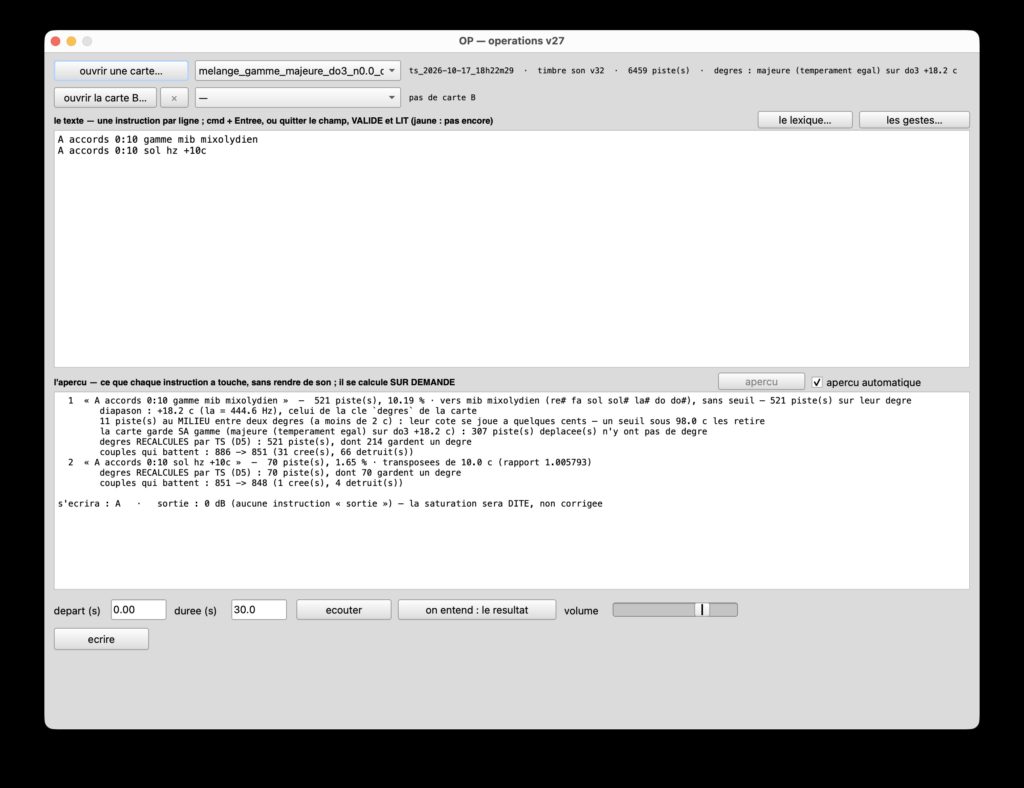
Each gesture has its own logic and vocabulary. NTSE’s command language is based on short verbal expressions that directly describe the operations to be performed. A command such as « A garder forts 2 » means, for example, that the two strongest partials of map A should be retained.
This vocabulary is not simply intended to make commands easier to use. It provides a way of naming, understanding and remembering the operations. The work is therefore carried out through an operational language that emphasizes relationships and actions rather than the manipulation of complex graphical representations.
The gestures can act on partials, their relationships, their organization and their evolution. They make it possible to construct new maps from existing material, according to principles that can be quite different from one another.
Allusions
Allusions is a new family of gestures that explores a different way of acting on sound material. Rather than directly specifying a transformation or a desired result, these gestures establish conditions and criteria from which certain transformations can emerge. Their parameters do not prescribe the precise events that will take place, but instead define the framework within which they can occur and evolve. The process involves an element of randomness, which can be reproduced using a random seed, allowing different realizations to be obtained from the same set of conditions.
Two gestures currently belong to this family.
Fremir explores vibratory phenomena, ranging from beats to roughness. It allows the user to define a range of vibration rates, expressed in Hertz, ERB, or a combination of both units, as well as the conditions under which these phenomena appear, their duration and their degree of irregularity. The user selects the partials involved and determines how they participate in the process. The result is generated as a complementary sound material, which can be mixed with the original sound and independently adjusted in a mixing application.
Fluer explores questions of tuning and intonation. It identifies foyers (spectral focal points) within the spectrum, corresponding to peaks in the spectral envelope, together with the frequencies surrounding them. These foyers can gain in amplitude and move in frequency according to criteria defined by the user. These include their poids (weight), which determines the inertia of their movements across different spectral regions, their relationship to a pitch grid, and the temporal conditions governing their evolution. Frequency shifts are not directly prescribed: they emerge from the combination of criteria established. The selection of foyers, the spacing between them and the choice of frequency range make it possible to distribute transformations across the spectrum without acting indiscriminately on all partials.
Progression
Among the gestures available in Opérations, Progression has a particular role. It makes it possible to construct harmonic progressions from spectral maps, without necessarily starting from predefined chords.
The gesture searches the map for families of partials exhibiting harmonic relationships, up to the fifth harmonic. When the system is able to reconstruct families with tonal relationships, these become the basis for the progressions.
The user can then choose different voice-leading strategies: parallel movement, for example, or the minimization of movement between successive chords, an approach that can notably evoke certain principles of neo-Riemannian theory.
The harmonic progression is not, however, independent of the spectral material on which it is based. Several playback modes make it possible to organize the relationship between the two over time. The map can be restarted from the beginning with each new chord, or playback can continue from its current position as the progression moves from one chord to the next.
When the harmonic progression extends beyond the duration of the map, several possibilities are available. A fade can be used to return to the beginning of the map. Alternatively, playback can continue by reversing the map in time: the end of the first pass then meets the beginning of the reversed pass, creating a perfectly seamless loop. The absence of clearly defined attacks in this additive synthesis material makes it possible to achieve this continuity without a perceptible break.
Vie (Liveliness) and Impureté (Impurity)
The parameters intended to make the sound material more lively are organized around two axes: Vie (Liveliness) and Impureté (Impurity).
Vie brings together temporal fluctuations and offsets that introduce movement into families of partials.
The Orchestre gesture offers two main mechanisms. The first introduces temporal offsets between the different voices. The second produces pitch variations for each voice, within a range defined by the user in cents. These variations are generated using a random seed, making it possible to reproduce an identical result. The user can also determine how frequently new values are generated: renewing them every 50 milliseconds produces relatively chaotic fluctuations, whereas intervals of six to ten seconds create broader, more gradual changes.
The Accident gesture allows the level of certain partials to increase momentarily, by an amount chosen by the user.
The Rugosité gesture can associate these accidents with additional partials called twins. These twins correspond to the original partials, but are displaced in frequency by a sufficient number of cents to produce the desired roughness.
Impureté concerns departures from an ideal spectral organization. It includes inharmonicity, but also different ways of transposing and transforming partials, for example towards lower frequencies. These operations make it possible to move the material away from an overly regular harmonic structure and alter its sonic character.
These two axes are not intended to apply a uniform effect to the material. Rather, they offer different ways of modifying its internal relationships and sonic behaviour.
Complementary maps
An important feature of the way NTSE works is that certain operations do not incorporate the desired effect directly into the original map. Instead, they can generate a separate, complementary map containing only the partials required to produce that effect.
This is notably the case with roughness. The user defines a roughness value in ERB. The programme then generates the additional partials, or twins, corresponding to the original partials but displaced in frequency so as to produce the desired roughness. A comparable principle is used to create beats: a complementary map contains slightly transposed partials which, when added to the original material, produce beats. Their frequency is specified in Hertz.
These operations can affect all the partials in a map or be restricted to a particular selection. It is possible, for example, to work only with the strongest partials, or to target a specific region of the spectrum, such as the midrange between 500 and 1,500 Hz, or the low frequencies.
The complementary maps can then be added to the original material in a digital audio workstation (DAW). The effect is therefore not permanently incorporated into the initial map: its level remains adjustable during mixing.
This principle is also used in Progression, where several elements associated in particular with Vie can be exported separately. The composer can then choose how to mix them with the main material in the DAW.
The production of sound material and its final balance are therefore not necessarily part of the same operation. Some gestures prepare separate elements that can be combined at a later stage.
Acoustics, psychoacoustics and composition
Research in acoustics and psychoacoustics plays an important role in the development of NTSE. Phenomena such as roughness, beats, consonance, inharmonicity and auditory segregation provide different areas of investigation.
They are not considered merely as phenomena to be observed, but also as parameters that can become compositional principles. The relationships between spectral structure and auditory perception can thus be explored, transformed and organized within musical material.
The aim is not to reproduce perceptual models systematically, but to investigate the musical possibilities they make available.
An exploratory approach
The development of NTSE follows a relatively autonomous research process. Scientific research in acoustics and psychoacoustics informs the project, while the tools themselves evolve in response to the musical questions that arise along the way.
The project does not take existing composition environments as models to reproduce, nor does it seek to define itself in relation to them. It follows its own course, developing a language and a set of operations suited to the questions it explores.
This approach leaves considerable room for discovery: certain possibilities are not defined in advance, but emerge during development and, in turn, become starting points for further research.
An ongoing project
NTSE is under active development. The three programmes evolve regularly, new operations are introduced, and existing possibilities continue to be explored and refined.
The project is conceived by Romain Kronenberg; the implementation of the programmes is carried out with the assistance of an AI-powered programming assistant.
The programmes are not currently distributed to the public. The purpose of this presentation is to describe an ongoing research project, its principles and the possibilities it explores, rather than to offer software that is available for use.
Youtube (English subtitles) : https://www.youtube.com/@NTSE-musique